Tuesday, 18 August 2015

NO IMPOSSIBLE MAN = NO CREDIBILITY

Right, so I went to see Josh Trank’s Fantastic Four tonight. It’s possible that you might have heard about it. You know, the film that got the lowest-ever score on Rotten Tomatoes? The film that’s the worst abomination cinema has ever known? The film that’s an affront to everything that’s good and right in the world? Why are we just sitting here gabbing when we could be tarring and feathering Josh Trank? THE MAN’S A MONSTER.


OK, stop. No. You've had your fun. Can we maybe, perhaps, stop being so hysterical about this thing? No, it’s not the best comic-book movie ever made. But you know what? It’s pretty far from the worst. Here are just a few shittier comic-book movies: X-Men Origins: Wolverine, Daredevil, Blade Trinity, Man-Thing. Batman Returns, Batman & Robin, Batman Forever, Superman III, Superman IV, Ghost Rider, Green Lantern. In my own personal rankings, Josh Trank’s Fantastic Four is probably on a par with Louis Leterrier’s The Incredible Hulk – which admittedly, is my least favourite MCU movie, but it’s by no means abominable (see what I did there?).

Some context first. Being primarily a lifelong X-Men fan, I’ve had a long time to get used to the idea that movies and comics are very different things. The first X-Men film offered only the merest of glimpses of my personal vision of Marvel’s Merry Mutants – and while I loved it anyway, it wasn’t without a certain amount of internal conflict about all the things they got completely wrong (i.e. changed for cinema). Eventually I reached the stage where I was comfortable with the idea that the cinema and comic universes were very different – complementary, perhaps, but their own entities. In many ways, the relationship between comics and cinema is much like Marvel 616 and the Ultimate Universe – the latter being a more streamlined, simplified, ‘cooler’ take on the former. It’s no coincidence that the movies have often turned to the Ultimate line for inspiration. And this latest iteration is no exception, plucking most of its story elements directly from the first couple of arcs of Ultimate Fantastic Four. The MCU also drinks deep from the Ultimate well – the most stark (excuse the pun) example being the casting of Samuel L. Jackson as Nick Fury, given that his likeness was appropriated for The Ultimates

Point being, I can happily see my comic films as parallel worlds or What Ifs?, as counterparts to the comics. I don’t require verisimilitude. The MCU and the Avengers do not, to me, feel like their comic counterparts, but I dig them both. 
I’m happy to take the films on their own terms, just as I take the comics in that fashion.

The one true Fantastic Four

Given all that, which is a roundabout way of saying a) this film is not very much like the 616 universe, and b) I'm not really all that concerned about that, what to make of Fantastic Four?

Taken on its own terms, it’s… well, a bit weird. The first two-thirds, a slow-burn sci-fi character study, are actually pretty compelling. The early bonding between child genius Reed Richards and best buddy from the wrong side of the tracks Ben Grimm is handled beautifully, and their bond is palpable and believable. Reed’s encounter with Franklin Storm and his induction into the interdimensional project is intriguing. And following the inevitable accident, the subsequent transformations, before our heroes learn to cope with their powers, make for some unexpectedly compelling, unsettling scenes of body horror.

But then there’s a sudden and huge leap – a ‘one year later’ leap. And it’s here where things start to unravel. Many others have mentioned this, but it really does feel like a big, generic mega-budget superhero blockbuster was awkwardly pasted onto a pretty interesting, simmering, atmospheric sci-fi flick, and the two don’t gel well at all. [Insert your own speculation here about studio interference and/or director meltdown and assign blame accordingly.] While there are some fun scenes in the latter third, the pacing becomes a desperate dash to the finish and it’s all ultimately a bit unsatisfying. What could have been an interesting, slower, quieter take on the superhero genre ends up as little more than a slightly confused prequel to some far better films that will most likely never be made.


A few closing points, good and bad.

GOOD: The Thing looks great in motion. Pants or no pants, this is by far the best rendering of live-action Benjy yet. Sometimes he feels like he could stand to have a little more weight, but he’s a sturdy presence nonetheless.

BAD: The best scenes from the trailer, of Ben being dropped from a place onto a military installation and wrecking the joint, were cut from the film at a late stage. A pretty shocking omission.

GOOD: Miles Teller carried the film as young Reed Richards, and to me inhabited the role really well. He had the awkwardness, the drive, the intense intelligence… could have used a little mania, but I liked him. In fact, all four team members were well cast, even if their interaction could have been handled better (see next point).

BAD: Before this film came out, I was confident that, whatever else happened, Trank (whose affinity for character work was well chronicled in, err, Chronicle) could relied upon to grasp what makes the FF unique – their family dynamic. But the ball was majorly dropped here. Reed & Ben were a tight lifelong partnership, and Sue & Johnny’s sibling relationship was good – tense and cool, though warming up – but as a quartet…? Reed and Sue had some extremely tentative flirting and burgeoning chemistry, but were basically work colleagues, while Johnny & Ben barely even speak to each other until the closing scene, and there's no real sense of the four as a team. Poor.

GOOD: For all the hoo-ha about Michael B. Jordan and Kate Mara playing siblings – because oh my god, how could that ever happen in real life, apart from all the ways in which it can and does happen?! – this was played nicely and not turned into a tiresome plot point. A brief mention about adoption, and that’s all (arguably, even that was unnecessary, as Franklin had already mentioned she was his daughter).


BAD: This is the big one. Dr Doom was absolutely bloody awful. No getting around it. Looked terrible. Had no presence. No menace. No aristocratic arseholeness. While, as mentioned, I don’t require faithfulness to the comic, this Dr Doom retained nothing that’s interesting about Victor aside from the name. Nothing. Not one thing. The great thing about Doom is that he is a self-made man of power, and as such considers himself superior to the misbegotten freaks of nature that are the FF. Why Trank decided to repeat the mistake of Tim Story and portray Doom as just another superpowered freak is beyond me. And worse, Doom here is no imperious, arrogant megalomaniac, but just a mopey, slobby nihilist bent on pointless destruction because… well, reasons, OK? He was essentially fruit-dehydrating maniac Eddie from Friends, covered in broken glowsticks and duct tape, with an ill-defined assortment of superpowers. Had this character simply been renamed Annihilus or the Molecule Man, it might have worked better, but this was just a colossal waste of one of comics’, nay fiction’s, most interesting characters. Crap, I tells ya. Crap! 

(Addendum: Come to think of it...he's a creepy looking techno-organic thing, has freaky cosmic powers, he's a nihilist bent on destruction, and lives in the frickin' Negative Zone. He bloody well IS Annihilus. Well, Annihilus-lite.) 

A mid-tier movie, then. Starts well, ends badly. Shit Doom. Far from perfect, but not deserving of the nigh-universal, excessive opprobrium.

Friday, 14 August 2015

THE DEFINITVE AND LEGALLY BINDING BUT NOT TECHNICALLY ENDORSED BY MARVEL STUDIOS ULTRON IS MY ELVIS MARVEL CINEMATIC UNIVERSE END OF PHASE 2 SUBJECTIVE EVALUATION REPORT AND OBLIGATORY REVERSE-NUMERICAL RANKING aka OO, LOOK, A LIST

With Ant-Man marking the end of Phase 2, it’s time to RANK ALL OF THE MARVEL CINEMATIC UNIVERSE MOVIES.

It's remarkable now to think back to how we saw the teaser scene at the end of Iron Man. Surely they're not really going to make an Avengers movie...? That would be both ridiculously ambitious and almost too exciting for words. And yet here we are, 12 movies down the line. Just as they revolutionised comics in the 1960s, Marvel have changed the face of cinema and TV, for good or ill, with big-budget superheroes dominating the summer season and interconnected universes springing up all over the place. We almost take it for granted, but it's quite a remarkable achievement for a new film studio. And what's even more remarkable is the overall quality of MCU films – 
I like them all, to a greater or lesser extent, some with reservations, some with unfettered adoration. Perhaps I'm shockingly easy to please when it comes to comic-book cinema, but I don't think there's a proper stinker in the bunch. Of course, the downside of this is that they've achieved this consistency by arguably being somewhat formulaic – but get around this by smartly adapting the formula to different genres (sci-fi, heist, fantasy epic, thriller). 

The exact order here could change from day to day. N
onetheless, there are three distinct tiers of goodness (1–3 are wonderful; 4–8 are great, but imperfect; 9–12 are good, but have considerable issues). 

So here goes, from worst to best...

12 THE INCREDIBLE HULK 


Actually pretty strong and engaging thanks largely to Edward Norton's portrayal of Banner, but I deem this by far Marvel’s weakest effort, purely by virtue of the nigh-unwatchable and horribly overlong final battle’s grotesque, jarring, PS2 cut-scene CGI. Plus, while Eric Bana and Mark Ruffalo are both somewhat visible in their respective emerald personas, Norton and his Hulk seem like two different entities entirely. Norton conveys the sense of the monster in the man, but we never feel the man in the monster.

11 IRON MAN 2


Nowhere near as dire as I used to think, but still a confused, meandering film with an extremely weak and unnecessary mid-section. It took several repeat viewings before I began to remember anything that happened in this film. Not a good sign. But Johansson, Rourke, Gregg and Rockwell are an excellent supporting team.

10 THOR: THE DARK WORLD


This attracted quite a lot of scorn from fans, but I actually enjoyed it quite a lot. There’s much to dig here: the full-on Asgardian sci-fi-ness, the surprisingly comedic tone, Kat Dennings, the inventive final warp battle. The major downside, of course, is the criminal waste of Christopher Eccleston as blank-cypher baddie Malekith. And the fact that Anthony Hopkins is virtually unconscious throughout.

9 IRON MAN 3 


I’m still not sure why this movie is so reviled. The Mandarin was never this interesting in the comics… What I like about IM3 is precisely the fact that Iron Man isn’t in it much. I really like broken-down Stark in Spy Kids mode. On the downside, Downey's schtick does begin to grate a little and pre-makeover Guy Pearce's geeky loser is a little on the nose. However, it has some of the best sequences in any Iron Man movie – barrel of monkeys, the beach house assault, the Mandarin reveal – plus the best final battle of the trilogy.

8 ANT-MAN 


One of the more fun MCU films. Great characters, innovative action, snappy dialogue, good comedy beats, compelling father-daughter themes, nice MCU connectivity… I particularly like the fact that although Paul Rudd was theoretically the lead, he was very much overshadowed, both in performance and in the storyline, by Evangeline Lily and Michael Douglas. It felt like their movie. It was entertaining enough that I’m willing to overlook its flaws – the ethnic stereotype sidekicks, cookie-cutter bad guy, the wildly inconsistent nature of Ant-Man’s powers, the disregard for Judy Greer, the whiff of being an Iron Man retread, etc.

7 CAPTAIN AMERICA: THE FIRST AVENGER 


Lots to like about this. A well-realised Cap in Chris Evans (though for me, he only came to fully inhabit the role in subsequent films), great period setting, enjoyable shifts in tone, Hayley Atwell in general, the Howling Commandos, Hugo Weaving chewing scenery… I find the pacing a little off though. A little too slow at some points, zipping forward via montage in others. And there’s no reason (except drama dictates) for him to crash into the ice. Go for that dance, you Star-Spangled fool…!

6 THOR 


Risky and preposterous it may have been, but Branagh's Thor is vastly enjoyable. Big in scope, from cosmic realms to small-town USA, funny, engaging characters, the MCU’s best villain yet, nudie Chris Hemsworth, Kat Dennings and a Kirby-design classic realised in the bloody Destroyer. Frankly, I’m not sure why it’s not higher.

5 IRON MAN


The original, yes, but not quite the best. While Downey Jr was made for this role, and almost everything about the film is note-perfect, tightly plotted and entertaining, the final battle is something of let down after everything that came before. Ending films is hard, clearly.

4 AVENGERS: AGE OF ULTRON 


I still haven’t managed a second viewing of this, but I did enjoy its immense sprawl, even if it was almost too much to take in at first glance. As a large-scale spectacle, far better than the first Avengers, but not quite as pacy or tightly written, nor does it quite have the absolutely bloody perfect moments of the first. 
And yes, it has some inexplicable Thor-in-a-pond nonsense. But it does have Ultron. And the Vision. And the Scarlet Witch. Eagerly awaiting the DVD…

(For a more on my feelings about this movie, go here: 
http://ultronismyelvis.blogspot.co.uk/2015/04/avengers-age-of-ultron-spoiler-free.html)

3 GUARDIANS OF THE GALAXY


Easily the funniest and most relentlessly entertaining of the MCU films, yet far from an empty piece of fluff. There’s a richness to the unabashed sci-fi world-building here that’s compelling and efficient. All of the main characters are fascinating and relatable in their own way, the music is great (and also a character), the visuals are just beautiful. Plus this has the best climax of any Marvel movie to date – when Quill says ‘You said it yourself, bitch– we’re the Guardians of the Galaxy’, it’s sarcastic but purposeful, triumphant but full of sadness too. Bloody masterful. Makes me want to both weep and kick down walls. If Guardians has a flaw, it’s that… come to think of it, it doesn’t. Blimey.

2 AVENGERS 


It’s difficult for me to fully express how excited I was prior to the release of Avengers. It felt like I’d been waiting almost 30 years for this film. And amazingly, it didn’t disappoint. I love pretty much everything about Avengers, start to finish, from Loki’s entrance to Natasha’s interrogation to ‘Shakespeare in the park’ and ‘I’m always angry’. Infinitely rewatchable.

1 CAPTAIN AMERICA: THE WINTER SOLDIER


While Winter Soldier doesn’t quite have the rewatch factor and gung-ho entertainment value of the others in the top three, it is for me the most interesting, impressive and well-made MCU film yet. Chris Evans really comes into his own here, Anthony Mackie and Scarlett Johansson are excellent in their supporting roles, the themes are big, surprisingly subversive and have real-world resonance, and the events of the movie caused a massive shift in the status quo of the MCU (at least for a while). But arguably the biggest star is the action – this film features some of the best, most exquisitely choreographed fight scenes outside of The Raid, Ong-Bak or Enter the Dragon. A big 70s conspiracy thriller mixed with dystopian sci-fi and bone-breaking martial arts brilliance? Count me in.

Saturday, 1 August 2015

THE HAND-JIVE OF DOOM

Our semi-regular geek cinema group watched the Corman FF film last night. And it's... certainly a film.

And whaddya know, the following morning the wonderful Fantasticast released their very own commentary episode (which I haven't heard yet, but I'm sure it's a blast...).


Made over a wet weekend in 1992 for roughly the price of a round down the Lamb & Flag (minus the Scampi Fries), Fantastic Four was rushed into being by producer Bernd Eichinger because his rights to the property were about to expire. Opinion varies as to whether he ever intended to release this thing (no pun intended), but certainly the cast and crew thought this was destined for a cinema release. Alas – or mercifully – it was pulled in advance of the premiere, and sealed in that massive warehouse from Raiders of the Lost Ark. For years only available on bootlegs from comic fairs, the film finally blossomed into being in the age of the internet, not quite gaining a cult following along the way.

On virtually all levels, it's a stinker. Painfully cheap, poorly thrown together, an ill-fitting mish-mash of styles, including some blatant homages to Burton's Batman films, cinematography that's questionable at best, poor action, shonky special effects, deeply unflattering costumes, dubious acting and a horrible '80s sheen all over everything.

OK guys, in this scene you're being tortured.
Look orgasmic, disgusted or bored. Up to you.

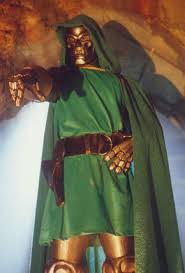
And yet... it's actually remarkably enjoyable. Not even necessarily in a so-bad-it's-good-way, either. The circumstances of its genesis mean you're willing to give it the benefit of the doubt. So what if Johnny Storm turns into a cartoon when he finally flames on? So what if the Thing looks like a gorilla made of sofa stuffing and his mouth is out of sync with his dialogue? So what if Dr Doom compensates for his face being hidden behind a mask by wildly overacting with his fingers? So what if Reed's powers are reduced to effectively duct-taping a glove to the end of a broomstick?

Reed Richards: godfather of the finglonger. 

There's an honesty and purity of intention that shines through the awfulness – you can sort of, if you squint, see what Corman and his crew were trying to do, but had neither the time nor the money (or possibly the talent) to even approximate it. True, some of it is just awful – e.g. the whole Jeweller character/side plot is abysmal – but there's some genuinely great stuff, too. In particular, every time Doom is on screen is a real treat, hand jive notwithstanding.

FOOLS!
The reason we watched this, of course, was as a precursor to Josh Trank's upcoming Fantastic Four. This film has, of course, been much reviled by geek communities throughout the multiverse. I'm still cautiously looking forward to this. While my excitement level for this movie is more of a simmer than a boil, the trailers have certainly not repulsed me in the way they have seemingly everyone else in the whole world. Quite the opposite, in fact.

The constant cries of 'It's nothing like the comics!' seem odd when it's clearly based heavily on the ultimate version of the team (the same universe that makes its influence felt pretty heavily in the MCU and the Fox X-Men films, incidentally). It's not that it isn't based on the comics, it's just based on comics that perhaps aren't the most fondly remembered by some fans. And that includes me – 'my' FF is Kirby/Lee, Byrne and Hickman, but I'm still interested in this take.


Another common criticism is that the FF is inherently goofy and wacky, and that Trank's 'gritty' take will be a massive departure from that. Putting aside the fact that it doesn't look that gritty to my eyes, I think this argument does the FF a disservice. The FF are an extremely mutable concept, able to handle all kinds of moods and modes. And the stories that made me connect with them as a kid were certainly not goofy, but pretty damn dark – in particular, Byrne's Psycho-Man/Hate-Monger/Malice saga was pretty disturbing to me. Fantastic Four, after all, is a book in which Doctor Doom at one point makes armour out of the skin of his dead lover.

The goofiness! 

What enables the FF to handle all kinds of stories is that they are a family. This is my big concern with Trank's movie. If he can get the interpersonal dynamics right, everything else will fall into place. If not, the whole thing will collapse. It's far too soon to say either way, but his work on Chronicle shows that he's very much character-driven.

Plus, my daughter is absolutely thrilled by the trailers and very excited to see it – which did provide a moment of horrifying clarity that perhaps the people making comic-book movies are not thinking primarily about 40-year-old obsessive geeks who get all upset if Alicia Masters wears the wrong type of cardigan, but are trying to take these characters to a new audience, a new generation.

Having said all that, reviews of the movie have been embargoed until the night of release, which probably means it's a sack of shite. We shall see.

Tuesday, 28 July 2015

HOW THE JLI CURED A CHRONIC CASE OF MARVEL ZOMBIFICATION

The fog of memory has somewhat obscured my first exposure to American comics, but I know that Marvel was my first love – it was either a handful of Avengers, Iron Man and Ghost Rider issues from a jumble sale; the first issue of Mighty World of Marvel (a UK reprint title, the first issue of which began X-Men’s Days of Future Past storyline); or #2 of the UK Secret Wars reprints.

[insert wibbly-wobbly flashback effect here]

Back then, mid-to-late ’80s, pre-internet, there was an insular tribalism to comics fans (totally unlike today’s open-minded fans, of course). I was Marvel. All my comic-reading friends were Marvel. The only people who liked DC were… well, a complete mystery to us. Marvel was inherently and self-evidently cool. Marvel was misunderstood loners, outcasts, outlaws, boozing, brawling demigods and haughty, ankle-winged fish-men. To us, DC was a combination of both dull and silly – stoic, barrel-chested, moralising paragons of virtue, who could lift planets or had magic rings and lassos or could run faster than light, engaged in childishly simple battles of good vs. evil. It was a whole ’nother world, one that in our youthful ignorance we mocked from afar without knowing a bloody thing about it. We were well into comics when Crisis happened. When Byrne’s Man of Steel dropped. When Perez launched Wonder Woman. When Vertigo began. But we never even noticed. Who could be enticed to cross the ultramenstruum when there were Claremont’s X-Men, Byrne’s FF and Stern’s Avengers to read? The only DC title to sneak under our radar was The Dark Knight Returns – one copy passed around the school, almost illicitly, like erotica found stashed in a thicket. Apart from that, it was all Marvel, all the time.

Until the ’90s. While not as comprehensively disastrous as their reputation would have you believe, these years were as unkind to Marvel comics as the ’80s were to jazz. My beloved X-Men in particular were badly hit. Things started to unravel around Inferno, but following the departure of Chris Claremont, after 17 years on the title, three issues into the new adjectiveless series, the title went into a horrible, disastrous tailspin of poor writing, macho posturing, godawful XTREME art and charmless crap. I stopped buying X-Men. I stopped buying Marvel. I stopped buying comics completely.

Unglaublich. 

But the urge never quite leaves, does it? And one day I found myself in our small-town comic shop. Well, not even a comic shop. Largely a roleplaying/wargaming shop with two or three longboxes of back issues tucked away in a corner. But you take what you can get. The owner was a lovely guy, a good friend, but the downside of being on first-name terms with a shop owner is that popping in for an idle browse to pass the time also entails a certain pressure to buy something. And so it was that, pretty much solely motivated by the desire to avoid embarrassment, I picked up two DC comics: Justice League #3 and #4, which came out approx. six years earlier (1987). I’d done a nice thing, but at what cost? I had crossed the Rubicon. Turned to the dark side. May Galactus have mercy on my traitorous soul.

The seeds of my downfall.

So why pick up these issues, as opposed to anything else in that box? For starters, two great covers, with beautifully clear, uncluttered and distinct artwork. They were physical and expressive, full of realistic proportions and relatable gestures – a far cry from the exaggerated Liefeld/Macfarlane-isms that had come to dominate ’90s Marvel comics. The colour palette was also appealing, bold but subdued, a version of reality only slightly enhanced. This art lives and breathes. Both covers outline a story, too. One shows a team in peril, surrounded by Soviet robots, or maybe men in armoured suits, backed up against a wire fence on which hang warnings of nuclear radiation. The other shows a team defeated, a lone figure left to fight an unseen, towering opponent. But in both cases – who was this team? I knew Batman, of course. And was vaguely aware of Captain Marvel and Green Lantern – though not this ginger-haired guy in the flashy jacket. But who were the others? The Justice League, at least as I was vaguely aware of it, was Superman, Wonder Woman, the Flash… Who the hell is Booster Gold? Or Blue Beetle? And what kind of vainglorious fool would call himself Mister Miracle? Danger, intrigue, a combination of the familiar and the mysterious, and gorgeous art… who could possibly resist that, even if it was *shudder* the dreaded DC?

Who are you people?

The interiors were no less revelatory. The tone of these issues was quite unlike anything I’d ever read at Marvel – an instantly compelling combination of warm human foible and upfront superhuman action. This series is renowned for its humorous approach, but in these early issues at least, it’s not silly. The humour stems from interaction and friction between a disparate group of characters, but the situations they find themselves in here are actually pretty grave – #3 revolves around the Cold War arms race, mutually assured destruction and nuclear meltdown. But nevertheless, these characters seemed like people first, superheroes second, even though they only appeared in costume. I’d get to know their names later, but right from the beginning these characters were Scott and J’onn and Ted and Dinah, rather than their own colourful alter-egos. The combination of J.M. DeMatteis’s snappy conversational dialogue and Kevin Maguire’s astounding knack for naturalistic facial expressions and communicative body language brought them to unprecedentedly vivid life. Take the scene where Blue Beetle and Black Canary, despite the present danger, forget themselves for a moment and discuss the work of Dostoevsky. It’s from this collision between the everyday and the extranormal that the best Justice League stories emerge.


While the humanity is bold and upfront in these two issues, they also excel when it comes to action. The sequence in #3 where the League try and fight off the Rocket Reds using minimal force (mostly) is a fantastic showcase of the Leaguers’ capabilities and personalities – from jingoistic arsehole Guy Gardner’s unbridled joy at the opportunity to beat up Russians; to the Martian Manhunter’s swift retrieval of the rogue Green Lantern; to Black Canary’s brutally efficient rooftop takedown; and Mister Miracle’s attempt at détente, following his barely concealed delight at completing another miraculous escape. #4 is even more action-packed, consisting of a long fight between Booster Gold (being foisted on the League against their will by then-mysterious corporate interloper Maxwell Lord) and the Royal Flush Gang. Some great moments here, as the cocky show-off Gold takes down the gang with only minimal difficulty (and a couple of blows to the head). However, he is defeated by the gang’s literal Ace in the hole (a giant adaptive robot), and the League charge ineffectively into the fray, with powerhouses J’onn J’onzz, Captain Marvel and Guy Gardner despatched with alarming ease, while Mister Miracle’s technological hubris takes a beating of its own. It eventually falls to Blue Beetle and Booster Gold to defeat the awesome android in a historic first team-up that foreshadows their future friendship.


Two hugely enjoyable issues in their own right, then, but their impact on me personally was enormous. Firstly, they brought to my attention some characters that would become very close to my heart – like Beetle and Booster, naturally, Black Canary, Captain Marvel. And Mister Miracle was a particularly fascinating character… despite the stupid name and possibly one of the worst costumes I’ve ever seen, somewhat reminiscent of throwaway Fantastic Four character Captain Ultra in its obscene gaudiness. His abilities were vague, potentially rooted in tech and weaponry, but there were hints that he’s far more than just a mere gadget man (as Miracle attempts to fly into a reactor in the midst of meltdown, Batman stops him, saying ‘Not even you could get out of there alive’). He spoke of things like the fire pits of Apokolips and a place called New Genesis, but the lack of explanation suggested that this stuff was assumed common knowledge. Scott Free, as presented on these pages, hinted at a rich, broad mythology, and would eventually lead to my discovery of and infatuation with all things Fourth World and Kirbyesque. 


But it was J’onn J’onzz who completely stole the show, despite (or because of) the fact that he did next to nothing in either issue. His appeal for me was summed up by a parody in Marvel’s humour comic What The…?!, where the Marshmallow Manhunter was depicted ‘reading the latest Just-A-League to  find out what my powers are – if any!’ In amongst all these quippy, bantering, brightly costumed humans stood a stoic, eloquent, imposing and clearly well-respected seven-foot green dude who exuded quiet dignity and a commanding presence. The lack of substantial information about this curious background figure planted a maddening seed in my brain, and over the next decade and more, as I attempted to track down all of his modern appearances, he gradually became my favourite comics character of all time. I may be a Marvel kid at heart, but my true allegiance is to Mars.


More broadly, these two issues showed me that I’d been completely wrong about DC. It was far from staid and boring, far from silly and simplistic. It was a universe that was just as rich and colourful and complex and multi-faceted as Marvel – maybe more so. If, after Marvel had gone downhill, #3 and #4 had not found their way into my hands out of sheer social awkwardness, I might never have crossed that line in the sand to DC. I might never have read all-time great series like Suicide Squad or Flash or the Five-Year Legion or L.E.G.I.O.N or JSA or Crisis or Animal Man or countless others. I might still dismiss DC as a lesser counterpart to Marvel, rather than a complementary entity. In fact, I might never have returned to comics at all. The longboxes in the wardrobe, the piles of comics by the bed, the sagging bookshelves of graphic novels – they’re all the fault of Giffen, DeMatteis, Maguire and a big green bloke wearing a mankini. 

(originally published on the Big Glasgow Comic Page)

Tuesday, 14 July 2015

FKA 'DEFINITELY GOING TO SURVIVE SQUAD', PRE LAWSUIT

Good day, bawlers and brawlers. Welcome once again to my BARGAIN BASEMENT OF DOOOOOM. There hasn’t been a visit to this greasy locale for quite some time, as while looking for some tasty back issues to showcase, I clambered up a stack of yellowing longboxes, triggered an avalanche and found myself trapped helplessly beneath several thousand copies of NFL SuperPro #1. I lay interned in a heap of low-grade gimmick comics, the hours turning to days, the days to weeks. I had to eat my own delicious flesh to survive. Soon, only my lips and teeth remained. But then, with one herculean Ditko-esque effort straight out of Amazing Spider Man #33, I was free. Free! Free to end this ill-conceived meandering digression and present this instalment’s cheapie-bin classic: SUICIDE SQUAD.

  
Well, perhaps not so cheap now. Their appearances on Arrow and in the (fairly dismal) animated film Batman: Assault on Arkham have already considerably raised the Squad’s stock – and with the just-released trailer for the upcoming 2016 movie, they seem set to go stratospheric and mainstream. It is therefore all the more galling that my entire run of Suicide Squad didn’t survive one of several brutal collection purges. This has led to no small amount of regret and a torrent of geeky tears that, despite their abundance and high saline content, inspire no sympathy from my wife and child, who apparently ‘need the space’ for their ‘things’.

My daughter's bedroom.
There have been several incarnations of the Suicide Squad, starting way back in 1959, but the one I’m talking about here first appeared in the 1987 Legends miniseries before graduating to its own title for a 66-issue run between 1987 and 1992.

Mostly written by John Ostrander and drawn by a number of artists – but most notably Luke McDonnell and Karl Kesel – Suicide Squad is one of the highlights of what I consider to be a particularly fertile period in DC Comics history. The concept is a pretty simple one: the Squad (known more formally as Task Force X - because the name 'Suicide Squad' was deemed off-putting to potential recruits during the annual quality-assurance evaluation of the recruitment process) is a group of extra-normal operatives, mostly super-villains, cajoled, coerced or threatened (by means of exploding bracelet) to take part in dangerous and dirty covert missions. As the Squad’s name implies, survival is very much not guaranteed, and quite a body count is racked up as the series progresses. Many, many wild and wonderful characters come and go, but the core team consists of Colonel Rick Flag Jr, Vixen, Bronze Tiger, Enchantress, Nightshade, Captain Boomerang and Deadshot. This motley bunch are brought together and (mostly) kept in line by the one-woman force of nature known as Amanda ‘The Wall’ Waller. A far cry from her tediously sexy New 52/Arrow revamp, the original Wall was a superb character – short, heavy-set and extremely domineering, gifted with no powers save for an acid tongue, a talent for subterfuge and an indomitable will. In #10, Batman decides to investigate this covert organisation. He takes down the entire team and finally confronts the Wall – who threatens him enough to make him scurry back to his cave with his pointy ears a’ droopin’. Yup, she beats Batman with words alone.


As an aside for Bat-fans, the series is also notable for featuring the first appearance of a post-Killing Joke Barbara Gordon, reborn (at first anonymously) in #23 as the information broker Oracle. She reappears throughout the rest of the series, and is the star of arguably the best cover of the entire run (#49).


The team’s first mission finds them going up against the Jihad – a pretty crassly named super-powered terrorist organisation that would return, in various forms, throughout the series. This conflict illustrates the advantages of working with villains, who take down the Jihad with no nonsense and little difficulty – even a cowardly fifth-rate crook like Captain Boomerang despatches his opponent with ruthless efficiency and a cold-blooded quip. In subsequent issues, the Squad become embroiled in political intrigue, mired in international incidents and deal with gangsters, terrorists and conspiracies. Although largely based in a super-powered spy/espionage milieu, the Squad’s adventures also took them off-world and into strange mystical realms – from Apokolips to Nightshade’s home dimension to the weirdly, wondrously psychedelic world of Steve Ditko’s Shade the Changing Man (who ended up joining the team).


Aside from the Wall, the standout character for me is Deadshot. With his complete lack of concern for his own mortality, Floyd Lawton most fully embodies the title of the series – be it gleefully attempting a blue suicide or an incredible scene from #54 where he enters into a Mexican standoff with the latest unwilling recruit, Russian super soldier Stalnoivolk (the Steel Wolf… a favourite character of mine), while plummeting, sans parachute, from a plane. The greatest and most celebrated Deadshot moment comes in issue #22, when Rick Flag decides to assassinate a corrupt senator who is threatening to expose the Squad. Waller orders Deadshot to stop Flag killing the senator – ‘by any means possible’. Deadshot’s overly literal solution? To shoot the senator himself.


Suicide Squad really stood out from the other titles on the shelf at the time, particularly those being put out by DC. Mainstream comics often operated in a clearly delineated binary of good and evil, whereas the Squad operated in a far murkier world of lies and manipulation and murder, of ends barely justifying means. Even its most sympathetic, honourable and quote-unquote moral character, Bronze Tiger, is a jaded former assassin, only too aware of the many shades of grey that ethics can encompass. It was also a remarkably violent title for the time, in the wake of the post-Watchmen/Dark Knight Returns darkening of comics, but before such things became gratuitous, overblown and absurd in the 1990s. However, it’s no empty, amoral splatterfest – there’s a really strong emphasis on character here, with great interplay between the main protagonists, and the team’s in-house chaplain, support staff and psychiatrists serving as tools with which to explore their warped heads.

In short, a fantastic series, much missed around these parts. I’m both excited and anxious to see the Squad transferred to cinema. Excited because of my love for the characters and the concept, and it looks like a pretty solid action flick. However, as soon as Joker turns up (and to some extent, cosplay mainstay Harley Quinn), I must admit… I just sigh.

Following severe dental trauma, former Coal Chamber drummer embarks upon lamentable career in cartoon mayhem.
One of the things I like about the Squad is that it consists of D-list villains and lesser characters, who form a fascinating group in their own right. The presence of such a huge pop-cultural icon as Joker, be it as a antagonist, supporting player or whatever, seems too blatantly obvious and cynical. It’s not even an aversion to Jared Leto’s nu-metal-style version of the character – I'm just bored of Joker being the go-to villain. I want a Suicide Squad film, not a movie where everyone's waiting with bated breath for a figure already familiar from a million T-shirts and tattoos. I don’t want Deadshot and Enchantress playing second fiddle to this overrated green-haired goon. With any luck, he'll just be there in flashback. But I wouldn’t count on it.

P.S. To whoever ended up buying my back issues – you’d better treat them well, lest I unleash my inner Waller.


P.P.S. Not Rik Waller.

(modified and extended version of post originally published on The Big Glasgow Comic Page)