The fog of memory has somewhat obscured my first exposure to
American comics, but I know that Marvel was my first love – it was either a
handful of Avengers, Iron Man and Ghost Rider issues from a jumble sale; the first issue of Mighty World of Marvel (a UK reprint
title, the first issue of which began X-Men’s Days of Future Past storyline);
or #2 of the UK Secret Wars reprints.
 |
| [insert wibbly-wobbly flashback effect here] |
Back then, mid-to-late ’80s, pre-internet, there was an insular
tribalism to comics fans (totally unlike today’s open-minded fans, of course).
I was Marvel. All my comic-reading friends were Marvel. The only people who
liked DC were… well, a complete mystery to us. Marvel was inherently and
self-evidently cool. Marvel was misunderstood loners, outcasts, outlaws,
boozing, brawling demigods and haughty, ankle-winged fish-men. To us, DC was a
combination of both dull and silly – stoic, barrel-chested, moralising
paragons of virtue, who could lift planets or had magic rings and lassos or
could run faster than light, engaged in childishly simple battles of good vs.
evil. It was a whole ’nother world, one that in our youthful ignorance we
mocked from afar without knowing a bloody thing about it. We were well into
comics when Crisis happened. When
Byrne’s Man of Steel dropped. When
Perez launched Wonder Woman. When
Vertigo began. But we never even noticed. Who could be enticed to cross the
ultramenstruum when there were Claremont’s X-Men,
Byrne’s FF and Stern’s Avengers to read? The only DC title to
sneak under our radar was The Dark Knight
Returns – one copy passed around the school, almost illicitly, like erotica
found stashed in a thicket. Apart from that, it was all Marvel, all the time.
Until the ’90s. While not as comprehensively disastrous as their reputation would have you believe, these years were as unkind to Marvel comics as the ’80s were to jazz. My beloved X-Men in particular were badly hit. Things started to unravel around Inferno, but following the departure of Chris Claremont, after 17 years on the title, three issues into the new adjectiveless series, the title went into a horrible, disastrous tailspin of poor writing, macho posturing, godawful XTREME art and charmless crap. I stopped buying X-Men. I stopped buying Marvel. I stopped buying comics completely.
Until the ’90s. While not as comprehensively disastrous as their reputation would have you believe, these years were as unkind to Marvel comics as the ’80s were to jazz. My beloved X-Men in particular were badly hit. Things started to unravel around Inferno, but following the departure of Chris Claremont, after 17 years on the title, three issues into the new adjectiveless series, the title went into a horrible, disastrous tailspin of poor writing, macho posturing, godawful XTREME art and charmless crap. I stopped buying X-Men. I stopped buying Marvel. I stopped buying comics completely.
 |
| Unglaublich. |
But the urge never quite leaves, does it? And one day I
found myself in our small-town comic shop. Well, not even a comic shop. Largely
a roleplaying/wargaming shop with two or three longboxes of back issues tucked
away in a corner. But you take what you can get. The owner was a lovely guy, a
good friend, but the downside of being on first-name terms with a shop owner is
that popping in for an idle browse to pass the time also entails a certain
pressure to buy something. And so it was that, pretty much solely motivated by
the desire to avoid embarrassment, I picked up two DC comics: Justice League #3 and #4, which came out
approx. six years earlier (1987). I’d done a nice thing, but at what cost? I had
crossed the Rubicon. Turned to the dark side. May Galactus have mercy on my
traitorous soul.
 |
| The seeds of my downfall. |
So why pick up these issues, as opposed to anything else in
that box? For starters, two great covers, with beautifully clear, uncluttered
and distinct artwork. They were physical and expressive, full of realistic
proportions and relatable gestures – a far cry from the exaggerated
Liefeld/Macfarlane-isms that had come to dominate ’90s Marvel comics. The
colour palette was also appealing, bold but subdued, a version of reality only
slightly enhanced. This art lives and breathes. Both covers outline a story,
too. One shows a team in peril, surrounded by Soviet robots, or maybe men in
armoured suits, backed up against a wire fence on which hang warnings of
nuclear radiation. The other shows a team defeated, a lone figure left to fight
an unseen, towering opponent. But in both cases – who was this team? I knew
Batman, of course. And was vaguely aware of Captain Marvel and Green Lantern
– though not this ginger-haired guy in the flashy jacket. But who were the
others? The Justice League, at least as I was vaguely aware of it, was
Superman, Wonder Woman, the Flash… Who the hell is Booster Gold? Or Blue
Beetle? And what kind of vainglorious fool would call himself Mister Miracle? Danger,
intrigue, a combination of the familiar and the mysterious, and gorgeous art…
who could possibly resist that, even if it was *shudder* the dreaded DC?
 |
| Who are you people? |
The interiors were no less revelatory. The tone of these
issues was quite unlike anything I’d ever read at Marvel – an instantly
compelling combination of warm human foible and upfront superhuman action. This
series is renowned for its humorous approach, but in these early issues at
least, it’s not silly. The humour stems from interaction and friction between a
disparate group of characters, but the situations they find themselves in here
are actually pretty grave – #3 revolves around the Cold War arms race, mutually
assured destruction and nuclear meltdown. But nevertheless, these characters
seemed like people first, superheroes second, even though they only appeared in
costume. I’d get to know their names later, but right from the beginning these
characters were Scott and J’onn and Ted and Dinah, rather than their own
colourful alter-egos. The combination of J.M. DeMatteis’s snappy conversational
dialogue and Kevin Maguire’s astounding knack for naturalistic facial
expressions and communicative body language brought them to unprecedentedly
vivid life. Take the scene where Blue Beetle and Black Canary, despite the
present danger, forget themselves for a moment and discuss the work of
Dostoevsky. It’s from this collision between the everyday and the extranormal
that the best Justice League stories emerge.

While the humanity is bold and upfront in these two issues,
they also excel when it comes to action. The sequence in #3 where the League
try and fight off the Rocket Reds using minimal force (mostly) is a fantastic
showcase of the Leaguers’ capabilities and personalities – from jingoistic
arsehole Guy Gardner’s unbridled joy at the opportunity to beat up Russians; to
the Martian Manhunter’s swift retrieval of the rogue Green Lantern; to Black
Canary’s brutally efficient rooftop takedown; and Mister Miracle’s attempt at
détente, following his barely concealed delight at completing another
miraculous escape. #4 is even more action-packed, consisting of a long fight
between Booster Gold (being foisted on the League against their will by
then-mysterious corporate interloper Maxwell Lord) and the Royal Flush Gang.
Some great moments here, as the cocky show-off Gold takes down the gang with
only minimal difficulty (and a couple of blows to the head). However, he is
defeated by the gang’s literal Ace in the hole (a giant adaptive robot), and
the League charge ineffectively into the fray, with powerhouses J’onn J’onzz,
Captain Marvel and Guy Gardner despatched with alarming ease, while Mister
Miracle’s technological hubris takes a beating of its own. It eventually falls
to Blue Beetle and Booster Gold to defeat the awesome android in a
historic first team-up that foreshadows their future friendship.


Two hugely enjoyable issues in their own right, then, but
their impact on me personally was enormous. Firstly, they brought to my
attention some characters that would become very close to my heart – like
Beetle and Booster, naturally, Black Canary, Captain Marvel. And Mister Miracle
was a particularly fascinating character… despite the stupid name and possibly
one of the worst costumes I’ve ever seen, somewhat reminiscent of throwaway Fantastic
Four character Captain Ultra in its obscene gaudiness. His abilities were
vague, potentially rooted in tech and weaponry, but there were hints that he’s
far more than just a mere gadget man (as Miracle attempts to fly into a reactor
in the midst of meltdown, Batman stops him, saying ‘Not even you could get out
of there alive’). He spoke of things like the fire pits of Apokolips and a
place called New Genesis, but the lack of explanation suggested that this stuff
was assumed common knowledge. Scott Free, as presented on these pages, hinted
at a rich, broad mythology, and would eventually lead to my discovery of and
infatuation with all things Fourth World and Kirbyesque.

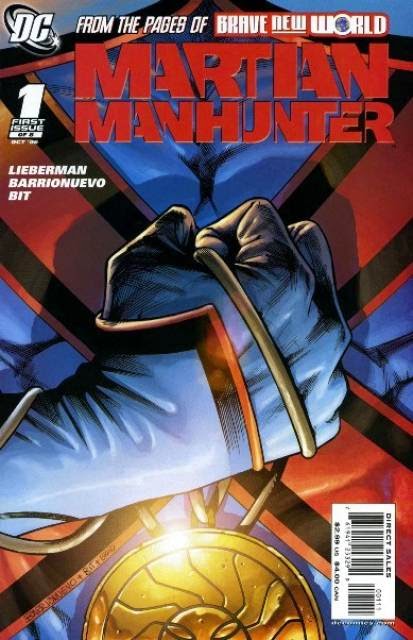
But it was J’onn J’onzz who completely stole the show, despite (or because of) the fact that he did next to nothing in either issue. His appeal for me was summed up by a parody in Marvel’s humour comic What The…?!, where the Marshmallow Manhunter was depicted ‘reading the latest Just-A-League to find out what my powers are – if any!’ In amongst all these quippy, bantering, brightly costumed humans stood a stoic, eloquent, imposing and clearly well-respected seven-foot green dude who exuded quiet dignity and a commanding presence. The lack of substantial information about this curious background figure planted a maddening seed in my brain, and over the next decade and more, as I attempted to track down all of his modern appearances, he gradually became my favourite comics character of all time. I may be a Marvel kid at heart, but my true allegiance is to Mars.

More broadly, these two issues showed me that I’d been
completely wrong about DC. It was far from staid and boring, far from silly and
simplistic. It was a universe that was just as rich and colourful and complex
and multi-faceted as Marvel – maybe more so. If, after Marvel had gone
downhill, #3 and #4 had not found their way into my hands out of sheer social
awkwardness, I might never have crossed that line in the sand to DC. I might
never have read all-time great series like Suicide Squad or Flash or the
Five-Year Legion or L.E.G.I.O.N or JSA or Crisis or Animal Man or countless
others. I might still dismiss DC as a lesser counterpart to Marvel, rather than
a complementary entity. In fact, I might never have returned to comics at all. The
longboxes in the wardrobe, the piles of comics by the bed, the sagging
bookshelves of graphic novels – they’re all the fault of Giffen,
DeMatteis, Maguire and a big green bloke wearing a mankini.
(originally published on the Big Glasgow Comic Page)