Showing posts with label X-Men. Show all posts

Wednesday, 17 February 2016

COLOSSUS: THE MOTION PICTURE - A REVIEW

Double confession: Despite expressing my lack of interest in the Deadpool movie, last night I went to see it.

Even more shamefully, I enjoyed it. Mostly.

In my defence, I had a free ticket courtesy of my friend, but even so, I felt a little grubby about the whole affair. Deadpool to me symbolises the very worst of ’90s comics, the tipping point at which Marvel turned to a crapfest of guns and pouches and everything being EXTREME. The arrival of Deadpool represented the start of what might well have been the slow death of my interest in comics. I turned away from Marvel, turned away from comics completely, only to be saved by a chance encounter with one of DC’s finest titles (as discussed at nauseating length here).

Maybe this whole comics obsession thing wasn't such a good idea after all.

So Deadpool had a mountain to climb to reach my affections. To make matters worse, I’ve never been able to stomach Ryan Reynolds in anything. Green Lantern, Blade Trinity, X-Men Origins: Wolverine… his snarky, cocky charisma clearly connects with lots of people, but I find him pretty much intolerable. Nothing personal, just a matter of taste. He's the cucumber of actors. 

And then there were the painfully unfunny trailers. It looked like a complete disaster. Never have I been less interested in a comic book movie – and I even went, with some mild enthusiasm, to see Fan4tastic, so this is a pretty low bar. Yet the entire geek community seemed to be absolutely in love with this dreck.

I have never felt so alone.

There was, however, one big, steel fly in the ointment of my wrath – Colossus. One of my favourite X-Men, one of my favourite Marvel heroes, one of my favourite fictional characters, full stop. And here he was, looking pretty good, with an actual personality and actual lines of dialogue, far more than he’d ever been given in any X-Men film. Damn you, Fox. Damn you. I may have no choice to see this after all.

Two-ton dreamboat.

So it came to pass that I found myself in a cinema, watching a Deadpool film, loathing myself a little bit. And it was… pretty good, as it happens. Utterly generic, but knowingly so. Some really great action sequences (especially the brilliant climactic battle), a startling horror atmosphere during one sequence, and some surprisingly sweet romance beats. The supporting players are for the most part excellent – Colossus was handled really well, and gets into some brutal action during his brouhaha with Gina Carano’s fantastic Angel Dust, who is in no way responsible for my burgeoning evil-women-with-quiffs-and-super-strength fetish. Brianna Hildebrand's Negasonic Teenage Warhead is a charmingly surly adolescent who packs a big punch, and Morena Baccarin’s Vanessa is a compelling romantic foil, albeit thanklessly relegated to the clichéd damsel-in-distress role during the third act.

Why no Monster Magnet cameo in this movie? Dave Wyndorf needs new bell bottoms.

On the downside, I recognise I have some baggage here, but my least favourite aspect of Deadpool was Deadpool himself. To be honest, little about the film served to change my mind about either Reynolds or Deadpool. It was unclear whether we, the audience, are supposed to like/sympathise with Wade Wilson at all. Yes, he undergoes a horrible ordeal and does everything he does in the name of love, but on the other hand he’s relentlessly annoying and a complete arsehole. It’s like being trapped in a wardrobe with Adam Sandler.

Further downsides are the agonisingly nondescript and forgettable main villain, who makes Ant-Man’s Darren Cross look like Dr Doom by comparison, and supposed comedy relief sidekick TJ Miller, who is roughly as entertaining as a dead dog floating in a toddler pool.

Squeeze, Gina. Squeeeeeeze.

My biggest problem with Deadpool is that, while it’s a pretty good comic-book movie, its focus is largely comedic. No bad thing in theory, except that, to be brutally honest, Deadpool is nowhere near as funny as it thinks it is. There are a handful of good gags, but the seemingly endless stream of witless duds is frankly wearying. If you buy into Reynolds’ smartass/dumbass motormouth schtick, maybe it’s a lot more effective, but his delivery just doesn’t work for me. In combining superheroics and comedy, it superficially has a lot in common with Guardians of the Galaxy, but the latter does so much more successfully – thanks in no small part to the naturally funny, dangerously personable and thoroughly dreamy Chris Pratt. 

What Deadpool does is weld a good, if formulaic formula superhero/revenge flick to a tiresome frat-boy comedy under the pretence of being subversive and irreverent. While there is some fourth-wall breaking and a few digs at superhero cinema (the X-Men franchise in particular), that side of it is relatively polite, almost cursory. But that's where Deadpool's real potential lies, and I feel the film would have benefitted from pushing these elements much, much further to create something far sillier and much bolder. And maybe it will do that in the inevitable sequel (which should ideally be called The Inevitable Deadpool Sequel). I’m thinking Adaptation meets Adventure Time meets Byrne's She-Hulk meets the end of Blazing Saddles. With katanas.


Tuesday, 23 December 2014

HOW SIKITTNEY WEAVER SAVED CHRISTMAS

Seasons greetings, yon sequential skinflints, and welcome to the last BARGAIN BASEMENT OF DOOOOOM of 2014. This is a bountiful time of year for the miserly at heart. Achieve sufficient levels of Scroogitude and you might just be rewarded with a paranormally fascinating visit from three ghosts of varying temporal dispositions, as well as one wrapped in chains – and who knows, sexy spectral times may even ensue if you’re lucky.

Today’s feature is, it’s fair to say, a blatant cheat. Instead of providing an overview of a title, it seemed apt to cover a Christmas special. However, most such issues are, frankly, terrible (JLA #60, anyone? Sensational She-Hulk #8? Yeesh). However, there’s one glaring exception, which is not only the greatest Christmas issue of all time, but a classic issue in its own right – namely, Uncanny X-Men #143 (1981). This was uber-penciller John Byrne’s last issue of his sublime X-run, and as such goes for a fair few grotes. However, it can also be picked up for next to nowt in #47 of the reprint series X-Men Classic (formerly Classic X-Men), and as such, with a little twisting and turning, qualifies for inclusion within the cheapskate remit of this column. 

Reprint cover by Steve Lightle (1990)

Original cover by John Byrne (1981)

Entitled ‘Demon’, this issue has a pretty simple storyline – not to mention a pretty familiar one. Forty or so issues earlier, the nascent post-Giant Size X-Men team had been plagued by some demonic types (the N’Garai) after Cyclops, wracked with guilt (as is his ongoing wont) had cathartically cut loose with his eyes, his accursed death-dealing eyes, ripped open an ancient cairn and unleashed the forces of hell. As usual, someone else had to clear up Scott’s mess, and Storm eventually managed to seal the gate to the underworld, entombing all the demons. Or so she thought.

Dave Cockrum, X-Men #96 (1978)

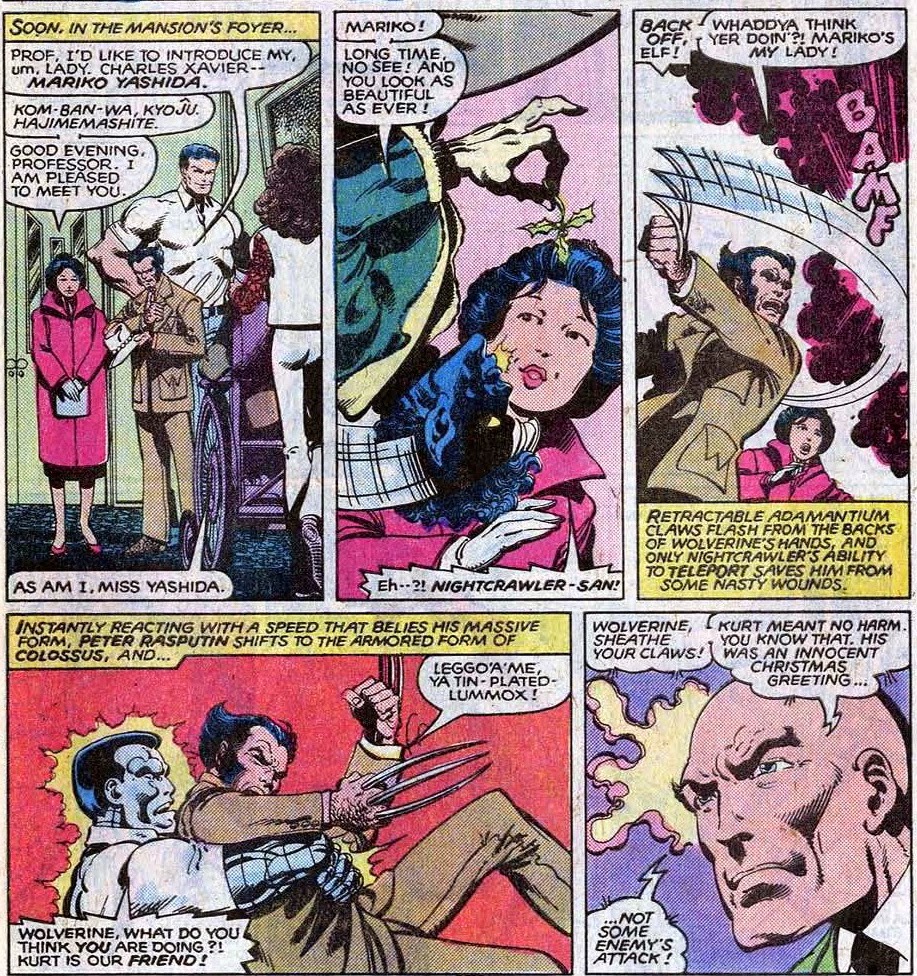
After a brief flashback to said events, #143 opens with the Christmas-tree-seeking adventures of Doug and Ellie Moore, a young, frisky couple keen to embark upon a long and happy life together, were it not for the leftover hellbeast that brutally extinguishes their future. Cut to the nearby X-Mansion, where the various team members are heading out for some Christmas Eve fun. After Wolverine introduces a note of tension into the evening by genuinely attempting to slice Nightcrawler in two for an etiquette misstep (the guy had severe anger-management issues in those days), everyone goes their separate ways, leaving the team’s newest and youngest member, Kitty Pryde, alone in the mansion. Her solitude is soon shattered, however, when the abode is invaded by the aforementioned demon, hell-bent upon feasting upon her entrails. The rest of the issue is essentially one long cat-and-mouse sequence, with Kitty forced out of the predatory role her name would imply. As she attempts to evade the creature, it becomes painfully clear that her mutant phasing power offers little defence, and she must rely on her wits to get out alive.


Beautifully rendered by Byrne (along with classic ink-partner Terry Austin), this issue not only borrows heavily from the recently released Alien, but is an entirely blatant homage – everything from the design of the creature to its eventual fate is taken almost directly from Ridley Scott’s film. As if the source material weren’t obvious enough, Kitty even directly references it – ‘Too bad I don’t have some king-size flame-throwers handy! They used them to fight the monster in that movie!’ There are also several instances of classic horror-movie tropes – the death of the sexually active couple, the severed phone-line, the Carrie fake-out.


For all its lack of originality, what’s great about this one-shot story is both its claustrophobic horror and its showcasing of Kitty’s capabilities and strength of character. The tension really gets ramped up as her attempts to use the mansion’s tech and resources to escape the demon prove increasingly futile (not to mention colossally destructive). ‘Demon’ is basically a Kitty Pryde solo story – she was only 13 or 14 at this time, had only appeared for the first time a dozen or so issues earlier, and had largely been behind the scenes since. She did play a role in Days of Future Past, but as her older self in her younger body (as you do). This is a great, rounded portrait of the young and inexperienced Kitty. She’s alone. Her power is unflashy and defensive. And she’s no warrior, grimacing confidently in the face of impossible odds. Naturally, she’s terrified – but, crucially, not scared witless… she beats the beast with brains, not brawn.


Clearly a favourite of Claremont’s, Kitty would go on to become a pivotal and much-beloved X-character, but #143 remains arguably her finest hour. All good Kittiness – from the Kitty Pryde and Wolverine mini through Excalibur to her Emma Frost-entombing exploits in Astonishing X-Men and beyond – stems from this.

That’s all for now… I hope you enjoyed this humble gift. May your Christmas be full of cheer, and relatively free from unstoppable 12-foot Giger-esque diabolical hellfiends intent upon ripping your flesh asunder and devouring your very soul.

(originally published on The Big Glasgow Comic Page

Thursday, 21 August 2014

THIS GREEN MILK TASTES FUNNY


Good day, waifs and weasels, and welcome once again to the fragrant catacombs of my BARGAIN BASEMENT OF DOOOOOM. What with all the revelling in Martianness, it’s been a long, long time since this irregular celebration of discounted dregs has turned its attention away from the DC universe, so let’s voyage across the ultramenstruum to the House of Ideas. Specifically, 1983 and THE NEW DEFENDERS. 


Launched in 1972 by Roy Thomas, the original Defenders title featured Dr Strange, Namor and the Hulk (and later, the Silver Surfer) as a highly dysfunctional assemblage of lone-wolf powerhouses, brought together reluctantly and in an ad-hoc fashion. Described as a ‘non-team’, over the next decade the Defenders had a series of fairly bizarre cosmic, occult and superheroic adventures (including a run-in with Howard the Duck) and a rotating lineup of second-tier characters, including Hellcat, Nighthawk and the Son of Satan. Just over a decade after its inception, and now with J.M. DeMatteis at the helm, it was time to kick over some bins and hurl insults at applecarts.

In issue #125, after being convinced of a prophecy that foretold the destruction of the Earth should they remain together, the original Defenders decided to disband – assuming, that is, that a team that was never really a team can disband at all. Waiting in the wings (and with wings, in several cases) were some secondary members, brought together by the Beast, clearly desperate for any gig he could get after leaving the Avengers a couple of years earlier. Along for the ride were his former X-Men teammates Iceman and the Angel, both somewhat adrift and seeking a new purpose; another ex-Avenger, the troubled, arrogant psychic Moondragon; and Defenders hangers-on Valkyrie (steel-boobed Asgardian angel of death and rider of the winged horse Aragorn) and the Gargoyle (a septuagenarian mystically trapped in the hideous tangerine-coloured body of a… well, you can probably guess).


If this seems like a motley collection, well, it is. In fact, it has echoes of the Champions, the ill-fated mid-1970s super-team that also featured Iceman and Angel, alongside Hercules, Ghost Rider and Black Widow. However, the Champions were an entirely random congregation of stray characters who had absolutely nothing in common and no reason at all to be together beyond lazy marketing strategies. The New Defenders, on the other hand, may also have featured a handful of founding X-Men, a mythical being and an occult monster, but they had somewhat stronger interpersonal connections. Indeed, the book went on to develop something of a bickering-and-learning extended family vibe, with Beast and Candy Southern (Angel’s girlfriend, who ended up leading the team) in relatively responsible parental roles, Gargoyle as a snaggle-toothed grandpa, Valkyrie as a cool, ass-kicking aunt, and Angel and Iceman as horny teenage boys lusting after disruptive hairless outsider Moondragon. No longer a non-team, this lot also lived together, first occupying a New York brownstone in a super-powered facsimile of The Cosby Show, before moving to Angel’s mountaintop aerie. Compounding the domestic vibe even further, the Beast even picked up a dog along the way, Sassafras –who simply vanished from Marvel continuity at the end of the series, seemingly abandoned by a neglectful Hank McCoy. Surely she’s due a vengeful comeback? The campaign for a Dark Sassafras limited series starts here. 


The revamped title got off to a relatively inauspicious start, with the New Defenders going up against the boilerplate villainy of the Secret Empire, led by Professor Power (kind of a tenth-rate Doctor Doom-lite clad in armour made of Lego, only crappier). There are some entertaining issues here though, with the team fighting sad-sack mercenaries Mad Dog and the Mutant Force, a gigantic baby-man called Leviathan and a virtual-reality version of the New Mutants. They also gain a new recruit, in the form of a former adversary Cloud, a teenage girl who turns into, well… you can probably guess. Her presence on the team leads to some remarkably awkward scenes that have not aged well. Cloud (like everyone else on the team) develops a crush on Moondragon, one that at first appears to be reciprocated. However, before this has a chance to develop into the first same-sex relationship in mainstream comics, Cloud undergoes a spontaneous gender swap, Moondragon loses interest, Iceman displays some regrettable transphobia and the whole romantic subplot is quickly forgotten.


After J.M. DeMatteis left the book with #131, Peter Gillis took over writing duties and steered the title into strange new waters. Where DeMatteis’s run essentially consisted of standard super-hero fare made interesting by a focus on character interaction, Gillis’s run was much darker, more mysterious, at times verging on a horror title. Indeed, One of the stand-out issues of his run, #134, is particularly creepy ­– essentially a slasher film masquerading as a superhero title. The team are being hunted by the assassin Manslaughter, who is somehow able to move unseen and unheard through their home. After monstrously taunting them for a while, he kills almost the entire team, one by one, in imaginative and grisly ways (though all is not quite as it seems, of course…).


Gillis’s run is notable not only for its weirdness and horror vibes, but for its sense of completeness and closure. His first issue (#132) relates the story of Ephraim Soles, a man mutated by gamma radiation into a vegetation-based creature. Though seemingly destroyed at the end of this first encounter, he/it survives as a cloud of spores. Much later, these spores infect some grass and are eaten by a cow, which becomes pregnant and gives birth to a horrific grassy man-cow thing. READ THAT SENTENCE AGAIN. In the meantime, it’s revealed that Moondragon’s irascible personality was due to her constant struggle to keep in check the ancient evil that dwells within, known as the Dragon of the Moon. She eventually finds inner peace only to be immediately and ironically infected by the spores of Ephraim Soles’ horrible grass-man-cow-baby-monster, and finally succumbs to the Dragon’s influence.


This leads to an extended multi-issue climax for the series, in which the team’s greatest threat comes from within. In 1986, the book was cancelled, but Gillis goes out in style in #152, concluding the Moondragon saga with an epic battle in which most of the team – and a few new members, including murderous former foe Manslaughter – are killed. This was, of course, a particular drag for Beast and Angel, having been through the exact same situation (telepath achieves ultimate power, turns evil, much death and horror ensues) with Jean Grey a few years previously. It’s a wonder that they ever agreed to work with a psychic ever again.


While the New Defenders is hardly among the greatest comics ever written, it’s definitely an interesting and worthwhile curiosity, strong on character, big on atmosphere, ambitious in its long-form storytelling and unafraid of exploring fairly out-there ideas (like, say, nightmarish cow-man-grass-type-things). Alas, its biggest weakness is its art. Most of the issues were pencilled by Don Perlin, whose work here is at best competent but perfunctory (and at worst, simplistic and lazy), never quite conveying the atmosphere, imagination and eccentric flair that some of the stories demanded. 


On the other hand, the series had some really spectacular, eye-catching and eerie covers by the likes of Kevin Nowlan, Bill Sienkiewicz, Butch Guice, Mike Mignola and Frank Cirocco. Had this series’ interiors been handled by any of that bunch – but especially Sienkiewicz or Mignola – it might well be considered a cult classic. As is, it seems all but forgotten.


Mind you, that could be because of the cow-man-grass-babychild-devil-creature from beyond hell. Which I wish I could forget.

(originally published on The Big Glasgow Comic Page) 

Wednesday, 11 June 2014

TECHNICALLY, IT'S KNOWN AS A SASQROTCH


Time once again to take a preventive antibiotic suppository and slither into the increasingly toxic Bargain Basement of Dooooom. This week, we’re heading west from our underground Scottish lair, but maintaining our latitude, on a visit to Canada’s finest: ALPHA FLIGHT (vol.1). Admittedly, this doesn’t quite fit this column’s penny-pinching remit, given that a couple of the early issues (especially #11 and #12) are fairly desirable. But still, most of them can be bought for beans. Canadian beans.  


Our first sighting of Alpha Flight came in Uncanny X-Men #109, way back in 1978, when Guardian (then known as Weapon Alpha, later Vindicator), the team leader, interrupted a picnic to forcibly return Wolverine to Canada. Nobody likes a ruined picnic, particularly not the X-Men, and Guardian was unceremoniously sent back oop north alone. A year or so later, in #120, the X-Men are stranded in Montreal and we finally meet Alpha Flight for the first time, as they try once again to retrieve their unwitting former comrade.

Both of these issues were pencilled by comics titan and legendarily difficult human being John Byrne. As an aside, he is the man who is largely responsible for Wolverine’s ubiquity. Early in the life cycle of the post-Giant-Size X-Men #1 team, Wolverine was not popular with readers or creators, and was in line to be killed off. For Byrne, a child of the north, it was a deal-breaker that the team included a Canadian. He then went on to almost single-handedly turn Wolverine into the star of the book (especially with #133 – but that’s a story for a more profligate column).


In 1983, Alpha Flight got their own title. Byrne, at that time busy with his own massively successful Fantastic Four title, somewhat reluctantly (surprising, given his forthright attitude towards representing his country) took on the title as writer and artist, and remained on board for the first 28 issues – not coincidentally, the only issues of Alpha Flight you really need. The initial lineup comprised Vindicator/Guardian in his maple leaf-adorned electro-magnetic battlesuit, magician Shaman, demi-god Snowbird, speedster twins Northstar and Aurora and man-monster Sasquatch. As first issues go, Alpha Flight #1 starts in a remarkably downbeat manner. The team’s funding and government backing has been withdrawn, and the opening splash features a redundant Guardian (James Macdonald Hudson) standing, despondent, in the shell of the headquarters he must now vacate. The team is in tatters, scattered across the country and facing an uncertain future, before a heedless John Lennon-looking imbecile summons a colossal (seriously, kaiju-scale) monster called Tundra, and everyone is called in to help, including some new recruits who never got the chance to be activated: amphibian Marrina and diminutive acrobat Puck.


From here on in, it’s a wild, strange ride. In only the second issue, Marrina rips open Puck’s guts, which leads to a confrontation with former Neanderthal/would-be conqueror The Master and a guest appearance from Namor and the Invisible Woman. Bizarrely, Byrne chooses to completely derail the team’s story at a very early stage, with issues #5–10 being solo tales for some of the key members. When they reconvene in #11 and #12, it’s for a deadly showdown with their arch-enemies Omega Flight, the ending of which was shocking then and still pretty traumatic even now.


What’s interesting about the weird, fractured structure of these first 12 issues is that it’s essentially a post-mortem. Alpha Flight, Canada’s premier super-team, have had their day. They’re past their prime, defunct, unnecessary. But, outside of three old X-Men issues, their supposedly illustrious history is never shown, barely even alluded to – Byrne doesn’t bother to build them up before he knocks them down. We begin with the team’s desolation, enjoy a brief revitalisation, then everyone goes their separate ways, only to reconvene for some punch-in-the-guts tragedy. It should feel hollow, but it works. It’s the diffuse, cobbled-together nature of the book that gives it its unique atmosphere. The characters subsequently began to cohere a little more as a team, but they would remain a fairly loose assembly until after Byrne left the book.


Alpha Flight is not so much a super-team book as a character study of a group of people, some of whom intensely dislike each other or are at best indifferent, who are perpetually down on their luck and plagued by myriad personal problems. Aurora suffers from a split personality; Northstar is an arrogant bastard, Olympic-level sports cheat and protective of his sister to a fault; Puck’s lovable rogue persona masks his constant pain and unrequited love for Guardian’s wife Heather; Sasquatch is losing control of the monstrous side of his being; Snowbird is rootless, caught between the worlds of men and gods; Marrina disembowels her team-mates without warning, without knowing why; Shaman, seemingly one of the few well-adjusted members, has a daughter who hates him, and for whose horrifying fate he would ultimately be responsible. As for James Hudson – a scientist rather than a leader or warrior – he’s the poor sap charged with bringing together this band of misfits. As the series goes on, his wife Heather takes an increasingly central role, and ultimately ends up with the heaviest burdens to shoulder.


For all the dubious attitudes that have become apparent in Byrne’s later years, there are two interesting socio-political aspects of early Alpha Flight: First, the development of Heather Hudson from an appealing but everyday supporting character to an extremely strong and competent (if powerless) leader of a bunch of metahumans, echoing the role played by Storm over in X-Men at the time. There’s an argument to be made for the at least feminist-lite leanings of young Byrne. No, really. His run as X-Men penciller, in which he was said to contribute heavily to storylines, was full of strong female characters (although, admittedly, this is something Claremont always excelled at too). In FF, Byrne took the underpowered, devalued and patronisingly named Invisible Girl and made her into the Invisible Woman – the most powerful member of the team (even if the traumatic means by which he did so were questionable at best). He also introduced She-Hulk to the team and established her as a strong, multi-layered, fan-favourite character (even if, both in FF and her solo series, he was very quick to use her sex appeal as a crutch – or even a flimsy plot point). However, although I’d argue that Byrne made a significant contribution to improving the representation of women in comics, he also inflicted his share of damage, all too quick to resort to objectification and sexualised violence. 

Secondly, and less equivocally, the subtle, sensitive treatment of Northstar’s sexuality. Due to the twin conservative twattery of the Comics Code Authority and Jim Shooter’s editorial mandates, Northstar was not allowed to come out as openly gay until #106 (1992). However, reading between the lines, Byrne makes his orientation entirely clear as early as #7 (1984), in which it’s strongly implied that Northstar’s old friend Raymonde Belmonde was a very dear friend indeed. Despite not being allowed to depict homosexuality, Byrne did so anyway, under the radar, presenting a mature relationship characterised by affection, respect and tenderness in way that’s in no way sensationalist or prurient or judgemental. 


All of Byrne’s run is worth a look, but those first 12 issues are one of the great comic runs as far as I’m concerned, not only for their curiously disjointed narrative arc, but for the strength of storytelling and characterisation. And not least, for the art. For a good few years, Byrne was perhaps the biggest comic-art superstar since Jack Kirby. His run on X-Men revealed him to be a major talent, his pencils extremely physical and robust, yet capable of great subtlety and powerful character moments. For me, his work on Alpha Flight, as much as he is said to be not fond of the series, is some of his best. The scene in #1 where Sasquatch attacks Tundra with the ferocity of a feral beast, but the effectiveness of a dormouse attacking a rhino, is one of the great underplayed fight scenes.


In fact, any time Sasquatch is on panel is a delight, as Byrne really conveys both his bestial power and his genius-level intelligence. Plus, he’s basically naked apart from the fact that he has a built-in hairy loincloth. One stiff breeze and the Comics Code Authority stamp would go up in flames. Byrne’s designs for the clothed members of the team are really well thought-out, too – each of the original lineup has his or her own individual costume, but on closer inspection all share complementary maple-leaf-inspired design elements. Byrne was also pretty damn audacious (or possibly contemptuous) – pressed for time with Fantastic Four duties, he set the sixth issue’s fight scene between Snowbird and Arctic beast Kolomaq in a blizzard, resulting in five pages that are entirely white except for sound effects and dialogue.

Following Byrne’s departure, Alpha Flight ran until #130, amazingly, with precious little to recommend in that time. Three more volumes came and went, to very little fanfare. Characters left and joined and lived and died and were resurrected, but that curious, dysfunctional Byrne magic was never again recaptured. 

(a shorter version of this article was originally published on The Big Glasgow Comic Page)