Thursday, 23 April 2015

AVENGERS: AGE OF ULTRON – A spoiler-free review


Given the name of this blog, you may not be surprised to hear that I was somewhat excited about Age of Ultron. My all-time favourite villain, the Adamantium Jesus himself (or vibranium, in this case – damn you, Marvel/Fox legal wranglings), a character that has intrigued me for more than 30 years, appearing on cinema screens, voiced by an expert at playing creeps and sociopaths – and a sequel to one of my favourite comic-book movies of all time. There’s no way this could disappoint, right?

Right?

The most honest answer I could give is: I don’t *think* it did. It’s a little difficult to tell. It’s just so relentless. The opening moments of the film hurl you straight into a massive – and impressive – action set piece that leads, more or less directly, to the creation of Ultron himself. And once the Big Shiny Sexyboy arrives on the scene, surprisingly early on, we’re off. There are few opportunities to pause for breath as the peril mounts, the action spirals out of control, and things just become exceedingly, unashamedly comic-booky. There are several points that are not jump-the-shark moments per se, but which may push suspension of disbelief a little far for casual audiences. If you’re willing to go with it (and hell yes, I am), it’s a wild and wonderful ride.

However, this unbelievable sensory bombardment, over a prolonged period, leaves you reeling, and makes it difficult to determine exactly how well the film holds together. My instinct is to say ‘Really bloody well’, but then again I’m easily impressed by lots of bright colours and loud noises. It’s a long film, but never feels like it – Whedon packs in a hell of a lot of, well, everything. Quieter conversational moments may be few and far between, but that’s not to say that he skimps on character. Far from it. Rather, the team’s and their antagonists’ personalities are at the fore and drive the story.


The cast are outstanding, with no weak links in the core team (Renner gets much more to do this time), and a big impact made by Paul Bettany as the Vision and, of course, Spader as the bad bad robot. It doesn’t give anything away to say Spader’s interpretation was not quite what I expected, but he inhabits the role with much devilish glee.

A second viewing will be essential to unpack exactly how successful a film Age of Ultron is, but suffice to say that as a cinematic experience it’s massive, beautiful, funny and dangerously exciting. I’m not sure that it has quite the individual ‘Wow!’ moments that stood out from the original, but a) some of that may have been shock of the new; and b) maybe there are, but the pace, scale and scope of Age of Ultron doesn’t quite give you the space to appreciate them, as six more come along a second later. There are several shots and sequences straight out of George Perez’s wildest, most fat-packed dreams, which it’s impossible to unpack or even fully comprehend without a pause button. Essentially, it adds the unfettered, way-out comic-bookiness of Guardians of the Galaxy to the central Avengers concept, turns the dial way into the red zone. It makes the first film look as still and contemplative as a Jim Jarmusch joint.


Tuesday, 3 February 2015

THE LETTER ON HIS HEAD STANDS FOR 'ASS KICKED BY BATROC'

Good morning starshine… the Earth says hello. And it also bids you welcome to the cheap but chafing environs of the BARGAIN BASEMENT OF DOOOOOM. Inspired by the eye-scorching splendiferousness of last year’s best comic-book movie without a Yondu, The Winter Soldier, I’m keen to revisit a relatively unsung (and crucially, most bargainous) period of CAPTAIN AMERICA.


Must admit, Cap is a character I’ve often struggled with. As a brightly coloured, morally upright paragon of virtue, he seems too virtuous to be interesting, too confident to allow for drama, too sanctimonious to be sympathetic. And as a patriotic character draped in a flag, he rankles me intensely on a political, symbolic level too. Yet there’s something about this guy that I find fascinating… Maybe it’s precisely because on the surface he’s the most whitebread, tedious, mom-and-apple-pie North American superheroic power-fantasy cliché imaginable, that he inspires writers to excavate further and deeper, to explore what makes this flag-wearing relic tick. Not only is Captain America a man out of time, he’s also a fictional character out of time – this two-fisted patriotic icon was created in the 1940s, and arguably that’s where he belongs. On the other hand, as a living anachronism, he’s both a useful tool with which to reflect on our era and a periscope to the past.

In recent years, Brubaker and Millar and Hickman and Remender have done fantastic things with this character. And with the release of Avengers and his two solo films, he’s been elevated to an A-list cinematic protagonist too. But prior to his current super-cool espionage/sci-fi-based renaissance, he spent many years being pretty square. One of my personal favourite Cap runs sits squarely in this era, from #332–#350 (1987–1989). Here, Steve Rogers is forced by the US government to give up his alter-ego and is replaced by John Walker – who turns out to be a stronger, meaner, murderier Captain America. Penned by Mark Gruenwald, this storyline emerged in response to fans asking why Captain America couldn’t kill (a precursor to a similar exercise in Batman).


Walker was at first arguably even more patriotic and morally resolute than Rogers, but less psychologically stable. Over his 18-month stint behind the shield, he increasingly went off the rails, his trail of bodies dotted with members of the Watchdogs, Ultimatum and the Resistants, as well as Professor Power, and his old colleagues Left-Winger and Right-Winger (no, really). 


At the same time, Rogers established a new, red-white-and-black identity (simply ‘The Captain’) and assembled a small band of allies, exploring ways of fulfilling and defining his purpose without the backing of official status or nationalist symbolism.


As celebrated as this arc is, with some issues fetching quite a few pennies, the less lauded period preceding it is equally enjoyable. Mostly penned by Mark Gruenwald, with a few early issues by Mike Carlin, the run from #302 to #331 is full of gems. Here we get Cap entering into a then-final, most-definitely-ultimate-and-no-backsies showdown with the Red Skull; taking on my favourite pesky but ultimately honourable foot-fighting Frenchman Batroc, as well as his partners Zaran and Machete, as they succeed in stealing his shield; going up against the monstrous but tragic Armadillo; teaming up with Captain Britain to fight Mordru the Mystic; encountering the mischievous Madcap; and a undergoing a four-issue showdown with the super-soldier-creating Power Broker. Throughout this period, Cap is a slightly lost figure, often itinerant and struggling to hold down a job as artist for the Captain America comic – an awkwardly circular concept that has quite staggering potential for establishing a regrettable trajectory towards a storytelling dead-end.


There are four particularly notable highlights of this run. The first is the introduction and ongoing development of the Serpent Society as viable foes for Captain America. These snake-themed villains may be a little hokey in a post-Brubaker milieu, but I always dug ’em – they were a motley assortment, ranging from avaricious but basically benign thieves to merciless killers, united only by their belly-crawlin’ inspiration and a leader whose teleportation powers promised that they need never again fear incarceration. They bickered, they squabbled, gained and lost members, butchered MODOK, tried to turn Reagan into more of a reptile than he actually was, and remained a slithery, venomous thorn in Cap’s side for years. And when Kevin Feige recently announced that the third Cap film would focus on these slithering snakes, I was thrilled – after that, the real announcement, Civil War, was frankly anticlimatic. 


Secondly, the Scourge storyline, which had been threading through the Marvel universe for a while, came to a head in #319 and #320. Scourge of the Underworld, a nameless, faceless assassin, had been popping up in a whole range of titles, executing minor criminals deemed surplus to Marvel requirements and/or hugely embarrassing. In #319 he thins the herd by a dozen-and-a-half in the space of a couple of panels – and lo, the universe did weep for the unimaginable loss of Commander Kraken, Rapier, Megatak and Turner D. Century. 


Third, in #321 and #322, Cap comes into conflict with his polar opposite – the fairly self-explanatorily-named Flag-Smasher. This is a man who believes in the dissolution of all nations and is sworn to destroy their symbols – so guess who’s no. 1 on his list (after Captain Canuck, Shamrock and Ursa Major)? What’s interesting about this tale is that it leads to Cap being forced to kill for the first time in his history (although considering he was a soldier who fought Nazis in WWII, this always seemed like a faintly ludicrous conceit), and the ramifications would haunt him for years.


Fourthly, issues #323 and #327 introduce us to the Super-Patriot, a more reactionary, less nuanced take on the flag-draped hero concept, a younger, more powerful upstart keen to take over Cap’s place as the USA’s foremost star-spangled icon. And this is exactly what he does, though not in the way he anticipates – eventually taking over from Rogers after he’s forced to step down, kicking off the excellent Cap No More! arc alluded to above.


So what’s the point of all this? There was once a time when Cap wasn’t a cool, bad-ass violence-vendor tailor-made for high-octane action and deep espionage, but a somewhat stuffy and wholesome figure, slightly lost and bewildered in a world not his own, trying to maintain his firm, old-timey grasp of right and wrong in a more complex era. They’re compelling and entertaining, well written and solidly drawn (courtesy of Paul Neary, mostly), embodying a curious mix of the philosophical musings and encroaching grimness of the modern age with old-fashioned four-colour hokum. For every political metaphor, moral dilemma or massacre, there’s a lady with snakes for arms. Or a man who looks like an armadillo. Or a human pinball bouncing across a giant typewriter. Or, most importantly, a Batroc.

And everything with a Batroc is good.

(originally published on The Big Glasgow Comic Page

Tuesday, 23 December 2014

HOW SIKITTNEY WEAVER SAVED CHRISTMAS

Seasons greetings, yon sequential skinflints, and welcome to the last BARGAIN BASEMENT OF DOOOOOM of 2014. This is a bountiful time of year for the miserly at heart. Achieve sufficient levels of Scroogitude and you might just be rewarded with a paranormally fascinating visit from three ghosts of varying temporal dispositions, as well as one wrapped in chains – and who knows, sexy spectral times may even ensue if you’re lucky.

Today’s feature is, it’s fair to say, a blatant cheat. Instead of providing an overview of a title, it seemed apt to cover a Christmas special. However, most such issues are, frankly, terrible (JLA #60, anyone? Sensational She-Hulk #8? Yeesh). However, there’s one glaring exception, which is not only the greatest Christmas issue of all time, but a classic issue in its own right – namely, Uncanny X-Men #143 (1981). This was uber-penciller John Byrne’s last issue of his sublime X-run, and as such goes for a fair few grotes. However, it can also be picked up for next to nowt in #47 of the reprint series X-Men Classic (formerly Classic X-Men), and as such, with a little twisting and turning, qualifies for inclusion within the cheapskate remit of this column. 

Reprint cover by Steve Lightle (1990)

Original cover by John Byrne (1981)

Entitled ‘Demon’, this issue has a pretty simple storyline – not to mention a pretty familiar one. Forty or so issues earlier, the nascent post-Giant Size X-Men team had been plagued by some demonic types (the N’Garai) after Cyclops, wracked with guilt (as is his ongoing wont) had cathartically cut loose with his eyes, his accursed death-dealing eyes, ripped open an ancient cairn and unleashed the forces of hell. As usual, someone else had to clear up Scott’s mess, and Storm eventually managed to seal the gate to the underworld, entombing all the demons. Or so she thought.

Dave Cockrum, X-Men #96 (1978)

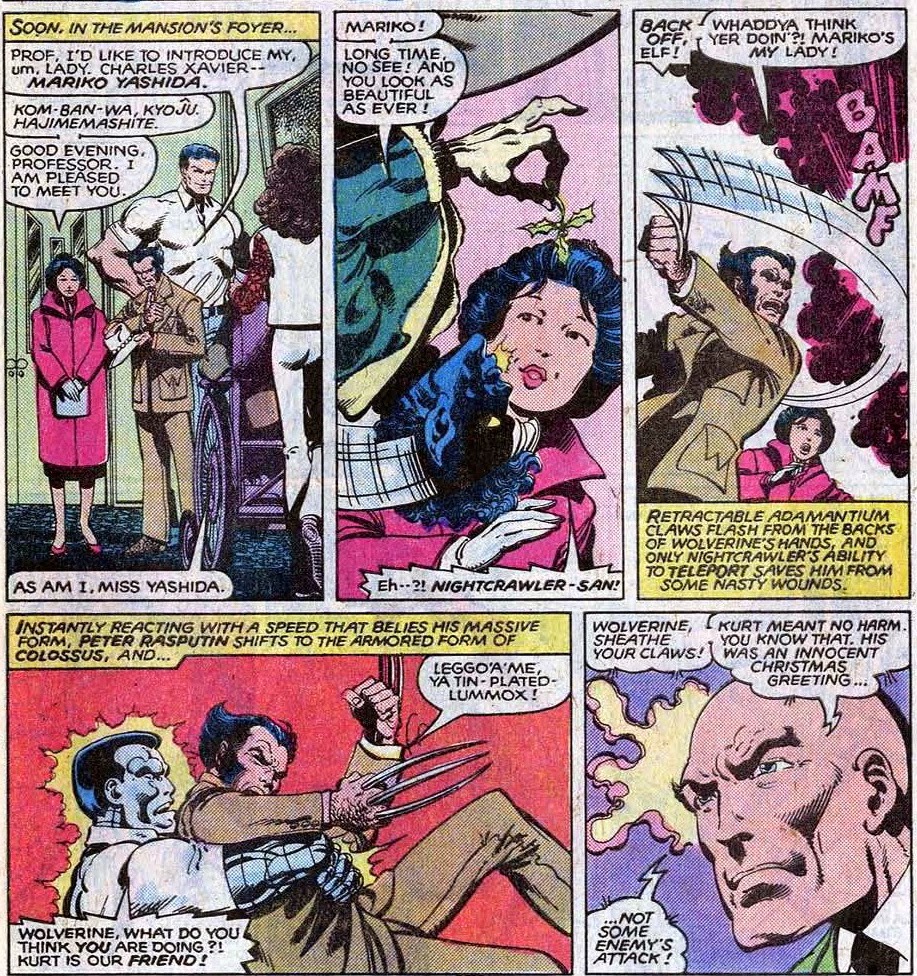
After a brief flashback to said events, #143 opens with the Christmas-tree-seeking adventures of Doug and Ellie Moore, a young, frisky couple keen to embark upon a long and happy life together, were it not for the leftover hellbeast that brutally extinguishes their future. Cut to the nearby X-Mansion, where the various team members are heading out for some Christmas Eve fun. After Wolverine introduces a note of tension into the evening by genuinely attempting to slice Nightcrawler in two for an etiquette misstep (the guy had severe anger-management issues in those days), everyone goes their separate ways, leaving the team’s newest and youngest member, Kitty Pryde, alone in the mansion. Her solitude is soon shattered, however, when the abode is invaded by the aforementioned demon, hell-bent upon feasting upon her entrails. The rest of the issue is essentially one long cat-and-mouse sequence, with Kitty forced out of the predatory role her name would imply. As she attempts to evade the creature, it becomes painfully clear that her mutant phasing power offers little defence, and she must rely on her wits to get out alive.


Beautifully rendered by Byrne (along with classic ink-partner Terry Austin), this issue not only borrows heavily from the recently released Alien, but is an entirely blatant homage – everything from the design of the creature to its eventual fate is taken almost directly from Ridley Scott’s film. As if the source material weren’t obvious enough, Kitty even directly references it – ‘Too bad I don’t have some king-size flame-throwers handy! They used them to fight the monster in that movie!’ There are also several instances of classic horror-movie tropes – the death of the sexually active couple, the severed phone-line, the Carrie fake-out.


For all its lack of originality, what’s great about this one-shot story is both its claustrophobic horror and its showcasing of Kitty’s capabilities and strength of character. The tension really gets ramped up as her attempts to use the mansion’s tech and resources to escape the demon prove increasingly futile (not to mention colossally destructive). ‘Demon’ is basically a Kitty Pryde solo story – she was only 13 or 14 at this time, had only appeared for the first time a dozen or so issues earlier, and had largely been behind the scenes since. She did play a role in Days of Future Past, but as her older self in her younger body (as you do). This is a great, rounded portrait of the young and inexperienced Kitty. She’s alone. Her power is unflashy and defensive. And she’s no warrior, grimacing confidently in the face of impossible odds. Naturally, she’s terrified – but, crucially, not scared witless… she beats the beast with brains, not brawn.


Clearly a favourite of Claremont’s, Kitty would go on to become a pivotal and much-beloved X-character, but #143 remains arguably her finest hour. All good Kittiness – from the Kitty Pryde and Wolverine mini through Excalibur to her Emma Frost-entombing exploits in Astonishing X-Men and beyond – stems from this.

That’s all for now… I hope you enjoyed this humble gift. May your Christmas be full of cheer, and relatively free from unstoppable 12-foot Giger-esque diabolical hellfiends intent upon ripping your flesh asunder and devouring your very soul.

(originally published on The Big Glasgow Comic Page

Thursday, 4 December 2014

GOT YER A BIG PLATE OF ALAN

[NB: The following was originally a series of postings on the Ultron is My Elvis Facebook page, made to mark the birthday of Mr Alan Moore.]

With his clashes with other creators, disdain for cinema and disparaging of his fanbase, Alan Moore seems increasingly difficult curmudgeonly. And it's arguable that his work can sometimes be problematic in terms of gender politics. Nonetheless, this big ol' beardy wizard remains near the top of my all-time favourite comics writers list by virtue of his revolutionary approach to and undeniable impact upon the form. 

Below are five reasons to love Alan...

(Portrait by Frank Quitely)

#1: Promethea

Promethea's a really interesting book in Moore's canon – not only his most fantastical and experimental, but his most personal too. It's an exploration of his ideas about reality and magic and spirituality and storytelling, and the myriad points at which these things intersect, told via the medium of a Shazam/Wonder Woman analogue. Moore really gets to play with the possibilities of the medium here, and you can almost taste his glee in using comics to repeatedly do incredible, eye- and mind-boggling things that no other medium is capable of... like this double-page spread of infinite time-looped conversation.

J.H. Williams III, Promethea #15 (2001)

Of course, none of this would be possible without the unbelievable skills of J.H. Williams III – surely one of the most distinctive, gifted and innovative artists to grace comics since Kirby, Eisner or Sienkiewicz.


#2: Top 10

This and the Tom Strong line are perhaps Moore at his most light-hearted, and it's a real gem. Top 10 is essentially an old-school cop show set in a world populated almost entirely by super-heroes, aliens, gods, monsters, robots and intelligent dogs wearing exo-skeletons. Think Hill Street Blues or Brooklyn Nine-Nine only without the tiresome baseline humans. It's a magnificent, sprawling offering, with great, relatable, three-dimensional characters, sharp and funny dialogue, beautifully lush and detailed art by Gene Ha, thousands of references and sight gags aplenty. And while it's not afraid to be very, very silly, there are moments of incredibly effective drama, too.

My absolute favourite moment though, is a pretty ridiculous cliffhanger splash. A 7-foot lizard-like gang member, Ernesto Gograh, is being held in police custody when his dad turns up to get him out. Gograh Sr, it turns out, is a 100-foot-tall drunk hillbilly monster in an offensive T-shirt. Enjoyable enough in its own right, but even moreso if you realise that this is not, as it first appears, a Godzilla reference, but an homage to the 1961 British movie Gorgo. This film sees a monster captured, imprisoned and taken to a major Metropolitan area, only to be later rescued by his much, much larger mother, who spends the latter half of the film stomping on a model London and pleasing me greatly.

Gene Ha, Top 10 #3 (1999)

#3. Watchmen

It seems to have become a bit fashionable to knock Watchmen in some geeky circles. There are several reasons for this. It's one of the two or three comics read by people who generally don't read comics, therefore seen as the dilettante's choice. Its mystique was ruptured somewhat by a loud and garish (though still pretty good) movie and some needless (though sometimes pretty good) prequels. It's generally considered at least partly responsible for crushing the innocence of superhero comics and ushering in a new dark age of grim and gritty stories. And, alongside Maus and The Dark Knight Returns, it is tediously omnipresent at the top of any list of the greatest comics ever made – but on this point at least, I'll defend it to the death. It more than deserves its acclaim.

While it can be read on one level as a great murder mystery/conspiracy story, Watchmen is breathtakingly rich, literary and allegorical, full of symbolism, recurring motifs, hidden detail and powerful imagery. The amount of work and attention to detail that went into these twelve issues beggars belief – Moore's script for the first issue alone was 101 pages of tiny type. However, all of this does not result in some chaotic splurge of information and flights of insane imagination, but a incredibly tightly interwoven and brilliantly coherent tale, beautifully and vividly rendered. This is Moore and Dave Gibbons using word and image as one, using the medium of comics to its fullest potential, and few who followed in its wake have come close to its ambition or realisation.


Dave Gibbons, Watchmen #5 (1987)

If you think Watchmen is overrated, then fair enough – but I'd implore you to revisit it. Every time you read it, the more you see, the more you realise you've missed. I've read it half a dozen times, but I'm nowhere near close to unpacking it. To read it is to see yourself as a comics reader, to realise what the medium can do for you – appropriately enough, it's its own Rorschach test.


#4. This interview with Stewart Lee

This was the first time I'd ever heard Moore speak. I remember listening to this on Radio 4, absent-mindedly wandering the streets of Clerkenwell. Far from an eccentric, irascible wizard-cum-hermit, he came across as an affable and surprisingly down-to-earth human being, AND introduced me to the wonder of the Super Moby Dick of Space.


#5. Captain Britain

I'm generally averse to flag-wearing characters, but Moore's work on Captain Britain makes for a very odd and underrated read. Unlike most superheroes, the Captain is almost a supporting character in his own book – and not particularly effective, smart, admirable, interesting or charismatic, though not comedically inept, either. For all his (relatively low-key) powers, he's a slightly dull and irritable everyman figure rather than a walking demigod, a guy who tries to do the right thing, even though he's not always sure what that is or how to go about it, and takes far more dives and bruises than his similarly ranked compatriots America, Marvel and Atom.


Like us, he exists in a chaotic world that he barely understands, only his is amplified to an absurd degree, full of peculiarly eccentric weirdness, pan-dimemsional beings, myths and fairytales brought to life, homicidal assassins, insane politicians-turned-gods, unstoppable artificial beings and squabbling aliens. It's his futile attempt to get to grips with the ridiculous theatre of his life that makes Captain Britain compelling.

As an added bonus, these tales are illustrated by probably my favourite artist of all time – Alan Davis (*insert celestial choir sound effect here*). His work is not quite fully formed here, but it clearly has incredible potential, and the slight roughness of it is pleasing in its own right.
Alan Davis, The Daredevils #11 (1979)